

In modern manufacturing, precision and quality control are paramount. Force and distance monitoring technology enables real-time tracking and data acquisition of pressing operations to optimize accuracy and minimize defects. Let’s take a look at how force and distance monitoring works, as well as the benefits this technology brings to manufacturing.
How Does Force and Distance Monitoring Work?
Force monitoring and distance monitoring technologies can be used separately or together. These technologies operate using similar mechanisms. Force and distance monitoring in factory presses use sensors and control systems to measure the force applied during pressing operations and the distance traveled by the cylinder rod. These measurements verify that parts are produced with consistent quality and meet specified tolerances. The data collected by these systems can be used to make process adjustments, detect problems, and optimize the pressing or assembly operations. To better understand this technology, let’s take a closer look at the core components.
Equip your press with force monitoring or choose a data enabled press for your production. Contact us today to learn more >>
Inside Force and Distance Monitoring Systems
At the heart of force and distance monitoring systems are various sensors and mechanical components designed to measure force and displacement accurately.
Force Sensors
Typically, the force applied by the press is measured using strain gauges or load cells. Strain gauges, often attached to a press frame, measure force by changing their electrical resistance when deformed, allowing them to measure the amount of force applied. Load cells, on the other hand, convert compression force into an electrical signal that can be measured and analyzed. These sensors are often placed strategically within the press to capture the force exerted during each operation accurately. Load cells can either be attached in-line with the cylinder rod or located in your tooling or anywhere the force of the cylinder rod is applied.
Distance Sensors
Linear displacement sensors are commonly used to measure distance. These can include linear variable differential transformers (LVDTs), potentiometers, or optical encoders (used only with servo presses). LVDTs measure linear displacement based on changes in inductance. Optical encoders use light to measure the revolutions of a motor used to control a servo actuator with high precision. These sensors provide electrical signals based on the movement and position of the cylinder or actuator rod, ensuring that positional feedback is captured at critical points throughout the press stroke.
Electronic Elements in Force and Distance Monitoring
Electronic systems play an important role in how force and distance monitoring systems work. These systems process the data collected by force and distance sensors and provide real-time monitoring and control.
Data Acquisition Systems
These systems capture and digitize signals from the sensors. They typically consist of analog-to-digital converters (ADCs), signal conditioning circuits, and data processing units. The ADCs convert the analog signals from the sensors into digital data that can be processed by the control system. Signal conditioning circuits ensure that the sensor signals are within the required range and free from noise.
Control Units
The control units use the digitized data and compare it against pass-fail criteria, enabling you to catch defects before they make it further down the line. These machines are equipped with microcontrollers or programmable logic controllers (PLCs) that run software to analyze the force and distance data. Based on this analysis, post-cycle feedback is presented to the operator or factory control system, allowing good parts to flow down the assembly line and bad or defective parts to be segregated, preventing field failures or further complications.
User Interfaces
Modern force and distance monitoring systems often include user-friendly interfaces that display real-time data and alerts. These interfaces allow operators to monitor the pressing process, review historical data, and adjust settings as needed. Advanced systems may also offer connectivity options for integration with factory automation systems and SCADA infrastructure.
Benefits of Force and Distance Monitoring
Implementing force and distance monitoring in factory presses offers numerous benefits that enhance manufacturing processes and product quality.
- Improved Quality Control: By continuously monitoring force and distance values against pass-fail values, manufacturers can ensure conforming parts are produced with each press cycle and modify settings, materials or processes if the press cycles are not meeting requirements. This reduces the likelihood of defects and improves overall product quality significantly.
- Increased Efficiency: Real-time monitoring and control allow for quicker adjustments when issues are detected, minimizing downtime and optimizing the pressing process. This leads to increased production efficiency and reduced waste.
- Enhanced Traceability: The data collected by force and distance monitoring systems can be logged and analyzed to provide detailed records of each pressing operation. This traceability is valuable for quality assurance, compliance with industry standards, and troubleshooting issues.
- Preventive Maintenance: Monitoring the performance of the press over time can help identify wear and tear or potential issues before they lead to machine failure. This enables preventive maintenance, reducing unexpected downtime and extending the life of the equipment.
- Cost Savings: By improving quality control, increasing efficiency, and enabling preventive maintenance, force and distance monitoring can lead to significant cost savings in manufacturing operations.
Air-Hydraulics Force and Distance Monitoring Air-Over Oil Presses
When process monitoring is merged with an Air-Hydraulics air-over-oil press, the result is a machine that combines the power of full-hydraulic and the quality assurance found in servo controlled equipment, at a lower price point than either.
Maximize production with a high efficiency, data-enabled hydropneumatic press today. Available in force capacity up to 50 tons.
View Our SIG-Series Force and Distance Monitoring Air-Over-Oil Presses >
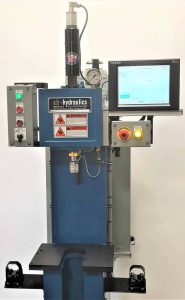
Force and distance monitoring technology is a critical component of modern manufacturing, providing the precision and control necessary for producing high-quality parts. By understanding how force and distance monitoring work, manufacturers can leverage this technology to enhance their pressing operations. To learn more about force and distance monitoring for your press machines, contact us today.