

Safety features on heavy equipment can have a number of effects on workers that allows them to accomplish necessary tasks safely and efficiently. However, depending on the type of equipment, these features can often be cumbersome and may introduce challenges to loading workpieces or changing out tooling from application to application. Light curtains are an innovative safety solution designed to protect workers while also maintaining operational efficiency. Aside from protecting workers from pinch point injuries during a pressing process, the protection offered by these safety devices can instill confidence in operators, as well as decrease the dependence on two-hand controls as the main safeguard against pinch-points. Let’s take a look at what light curtains are, how they function, their advantages for worker safety, and how they compare to other safety measures for industrial presses.
What Are Light Curtains?
Light curtains are a type of machine safeguarding system that utilizes laser beams across openings to detect the presence of objects or people within a designated area. They are commonly used in environments with large and potentially hazardous machinery, such as factory presses. Let’s look at how this works in those cases.
A light curtain consists of two main components:
The Emitter: This device emits beams of infrared light across the protected zone.
The Receiver: Positioned opposite the emitter, it detects the light beams.
Together, they create an invisible “curtain” of light. This “curtain” is, of course, actually a series of infrared light beams. If any of these beams are interrupted—such as by a hand or another object entering the press working area—the light curtain immediately sends a signal to stop the machine or retract, depending on the desired safety condition. This quick response minimizes the risk of injury by halting operations before harm can occur.
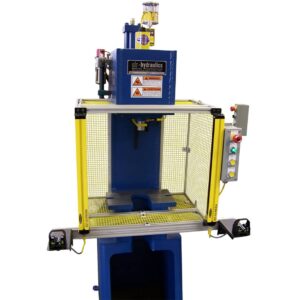
This 5.5 ton Air-over-oil press is equipped with light curtains to provide optimal safety with open access to the press working area for loading and unloading the workpieces to assemble.
How Do Light Curtains Work?
The basic principle of a light curtain is simple but highly effective. As previously mentioned, light curtains consist of a series of infrared light beams that create a “curtain” around the area. This curtain is invisible, but highly effective when it comes to keeping workers safe. Here’s how it works:
- Infrared Light Beams: The emitter sends multiple parallel light beams across the working area to the receiver. These beams are spaced at regular intervals, creating a grid.
- Monitoring the Grid: The receiver continuously monitors whether all the beams reach it.
- Detecting Interruptions: If one or more beams are broken—indicating that something has entered the hazardous zone—the system triggers a response. For presses, this response is typically an immediate stop or return of the ram or tooling operation.
Modern light curtains often integrate additional features, such as muting, which temporarily disables beams in a specific area for tasks like material loading, and blanking, which allows certain beams to remain blocked for pre-defined operations. This gives the mechanism more flexibility to work around the task at hand, while also providing necessary protection.
Advantages of Light Curtains for Worker Safety
Light curtains provide several key benefits which improve safety, without making a job needlessly difficult or time-consuming. Since the barrier is invisible, it won’t get in the way, and allows workers to comfortably work within the space and around the machine.
- Enhanced Worker Protection
- Light curtains can prevent accidental hand or body placement in dangerous zones, dramatically reducing the risk of injuries.
- Non-Intrusive
- Unlike physical barriers or guards, light curtains do not obstruct the operator’s visibility or interfere with workflows. This improves usability while maintaining safety.
- Flexible
- Light curtains can be configured to protect a wide range of machinery and tasks. Adjustable heights and beam resolutions allow for tailored safety solutions based on specific machine sizes and work areas.
- Operational Efficiency
- Because they don’t physically block access, light curtains allow operators to work faster than traditional barriers, streamlining production processes without compromising safety.
- The addition of these safety devices also decreases reliance on two-hand controls as the main safeguard against pinch point injuries, opening up the ability to use automatic mode. This provides a two-part boost to production efficiency, as operators can start the press cycle with a quick push of a button, with confidence that the required force will be met, as the possibility of human error from early release of controls is removed in auto mode.
- Compliance with Safety Standards
- Light curtains help businesses meet regulatory requirements, such as ISO 13849-1, which mandate safeguarding measures for industrial equipment.
How Do Light Curtains Compare to Other Safety Features?
Light curtains are just one protective feature that can make industrial presses and other assembly and manufacturing equipment safer. Each of these safety features is different, and provides different advantages and disadvantages. Here’s how light curtains differ from other options:
Physical Guards
There are a variety of different fixed barriers that block access to hazardous zones. While effective, they can hinder visibility and slow down operations, requiring workers to remove and replace them frequently. Light curtains offer the same protection without physical obstructions, enabling faster workflows and reducing setup time.
Pressure-Sensitive Mats
Pressure mats trigger a machine stop when weight or pressure is detected in the danger zone. While effective, they can be less precise and are prone to wear and tear. Light curtains provide a more precise and immediate response, especially in applications requiring high-speed machinery.
Two-Hand Controls
Two-hand controls require the operator to use both hands to activate a machine, ensuring their hands are not in the danger zone. However, they don’t prevent other body parts or objects from entering hazardous areas. On the other hand, light curtains protect the entire work zone, not just the operator’s hands, offering more comprehensive safety coverage.
Are Light Curtains Right for Your Applications?
Light curtains are a powerful and effective part of a comprehensive safety strategy for industrial presses. Their ability to combine safety, efficiency, and adaptability makes them a valuable investment for businesses seeking to protect workers while maintaining productivity. Light curtains are effective for a wide variety of different applications, but it’s still important to consider all your options to optimize your press for your applications. Our press experts can help you choose the right safety mechanisms for your press, and make sure it’s outfitted for optimal operation. Contact us to learn more about industrial presses, safety features, and more.
Note: Proper installation and use of light curtains are equally important to fully safeguard press operators and other workers involved in pressing applications. Air-Hydraulics Inc. always recommends that end-users run through a safety self-assessment to ensure that safety requirements are met throughout the application process.