

Pneumatic presses can be used in a variety of manufacturing and assembly processes. These types of presses are relatively energy-efficient and space-efficient, while also providing a high level of force. Choosing the right industrial pneumatic press can help you get the perfect fit for your process, and increase productivity and efficiency significantly. This checklist can help you find the right pneumatic press for your project or application needs.
How to Choose the Best Industrial Pneumatic Press
Process Assessment
The first step in choosing the right industrial pneumatic press is process assessment. By assessing the processes you need to complete, you’ll be able to pinpoint the specifications of your ideal press. Here are a few things to consider in your assessment:
- Static or Adjustable: Do you need a press for one dedicated process, or do you need a press that is flexible for use in different applications and can be easily adjusted for various processes?
- Application: Do you need your press for stamping, shearing, broaching, punching, or something else? What are the main requirements for the application: high speed or accuracy and/or consistency?
- Speed: What would be the most efficient operational speed for the press? This might be dependent on the surrounding processes. If your press works too slowly, it will cause a bottleneck, impacting your operations down the line.
- Materials & Tolerances: Some materials and tighter tolerances will require more force than others, so knowing your materials and part tolerances will be important for finding the right press.
Understanding the press specifications that will fit your intended application is critical to selecting the best air press model, as not all pneumatic presses are designed or function the same way.
Take for instance our two lines of air presses; the AP-Series Air Press and the A-Series Adjustable Air Press, both are designed with features that are beneficial for particular applications or facility requirements.
The AP-Series Air Press features a compact, robust frame that has minimal deflection for those small precise application projects. It also does not require lubricated air, which makes it a great choice for clean room environments.

Whereas, our A-Series Adjustable Air Press offers flexibility by featuring an easy full head cylinder adjustment design, which is ideal for die-set applications and for changeover between applications.

Quality Assessment
Once you have the press requirements determined based on your process assessment, you’ll want to choose a proven manufacturer for your pneumatic press investment. Without viewing or testing each press in person, it can be difficult to determine the best quality-to-price for a new air press. However, there are several indicators that can help you identify quality press manufacturers. First person customer reviews and testimonials are obvious places to start, when available. Case studies also give insight into product quality, options and capabilities of manufacturers and press engineers. Look for or ask about press longevity and product support available after purchase. Think about getting answers for questions like “where is the press manufactured?” and “are replacement parts and support readily available?” to ensure press maintenance will be quick and easy over down the road.
In the end, you’ll want to choose a supplier that offers the most reliable and best overall quality for your investment. Whenever possible, it’s also important to source a press domestically, with a supplier who is able to service or supply parts for your press quickly to prevent long periods of down time when maintenance is required.
75+ Years of Manufacturing Quality Press Equipment with Proven Results. View Air-Hydraulics Air Presses >
Space
Different presses can vary widely in size and shape. One of the advantages of pneumatic presses is their compact size. Choose where your press should go, and measure the space available. This might include floor space or benchtop space. Make sure you have enough clearance available for workers to move around the press comfortably and safely, as needed.
Consider the space surrounding the press as well. This might include doors, cords across the floor, fans or flying sparks, and areas where people, components, or materials frequently move though. Even the best pneumatic press won’t be effective if it’s not comfortable and safe to use.
Force Requirements
Pneumatic presses also vary widely in their force. Powerful pneumatic presses can provide thousands of pounds, and even hundreds of tons of force, which is more than enough for most jobs. Consider how much force you need for your applications; this will ensure your press performs optimally, without expending extra energy or incurring excessive costs.
Optimization
An optimized pneumatic press can save substantial energy. The US Department of Energy estimates that press efficiencies can reduce energy costs by 20 to 30%. This includes pneumatic optimizations like right-sized cylinders, reducing tubing length, improving seals, eliminating leaks, and regulating system pressure.
Additional Functions & Features
Choosing the best industrial pneumatic press means not only choosing the right press model, but also choosing the right additions and capabilities. Equipment to increase the press capabilities, like force and distance monitoring can make your press more efficient and accurate, helping to reduce defects and improve process efficiency overall. Automation can increase speed and productivity substantially. Sensors and factory monitoring devices can show when repairs or maintenance are needed, when energy expenditures are higher than normal, and much more. These, and many other equipment upgrades, can make your press stronger, faster, and more productive.
Safety Features
It’s also important to consider how the press is designed in terms of operator safety and ergonomics. If a press you are considering does not have the required or desired safety features, can they be added to the press package? Many industrial pneumatic presses can be equipped with two-hand controls (standard with all AHI air presses), barrier guarding, light curtains and other features that enhance the safety for operators and others on the factory floor. Depending on your application and factory layout, some of these features may be required.
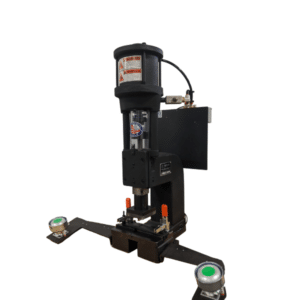
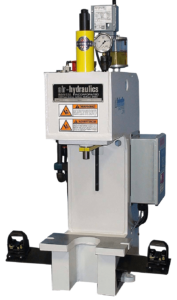
We produce two lines and 7 models of customizable air presses, delivering from 150 lb. to 2.5 tons of force to meet your industrial production and assembly needs.
View Air Hydraulics Inc. Air Presses>