
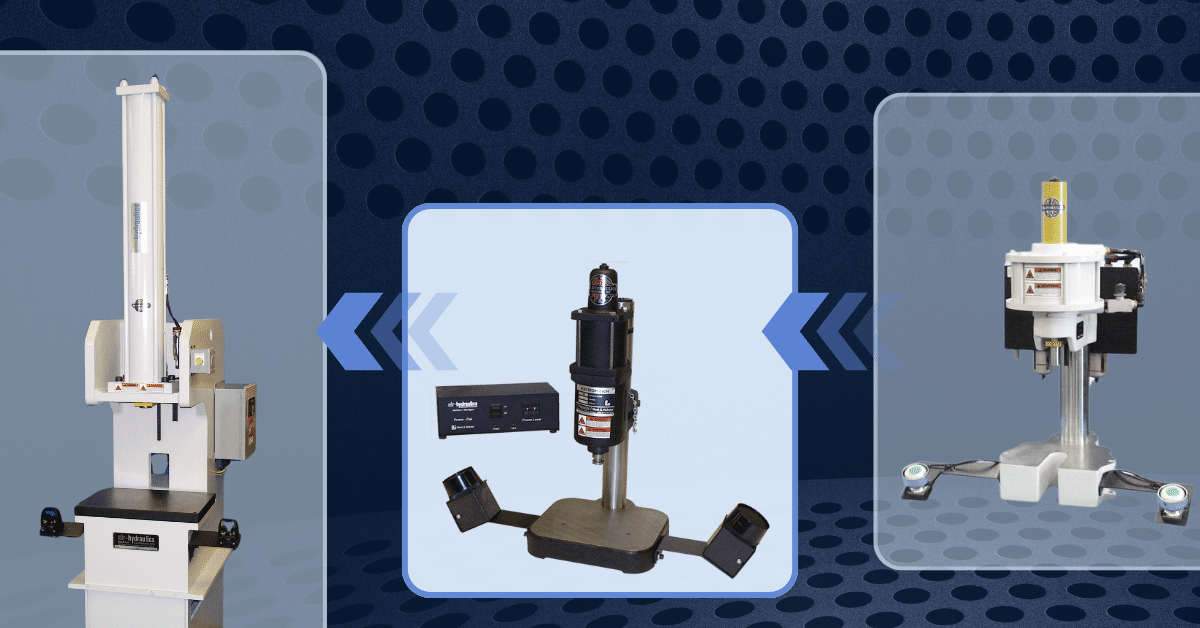
Metal punching applications are some of the most common processes completed by industrial presses. When working with punching processes, it’s important to select a press that will deliver the right amount of force, paired with the level of control that will produce a quality finish. Let’s take a look at a few considerations to help you choose the best presses for punching applications.
First, Assess Your Punching Process
To find the best presses for punching applications, it’s important to assess your process first. Here are a few things to consider that will help you find the right press:
- Material type: Nearly any type of metal or alloy, as well as plastics, wood, and more, can undergo punching by press. However, tougher materials will require more force, and more brittle materials may be damaged by too much force or too high of speed during the power stroke or return.
- Thickness: Thicker materials will be harder to work with, and will require more force. Consider the thickness of all the materials you’re working with.
- Pressing Action: High speed impact vs. consistent pressing pressure. Consider what type of material is being used to determine if high speed or consistent pressure is needed to achieve the required punch though on the material.
- Complexity: Are you performing only one punching process, or multiple processes at once? This will impact the configuration and functionality of your ideal press.
- Placement: Where will you place your press in your factory or shop? How much space is available? Will the press be free-standing, or will it sit on another surface? This can help you determine the right size and configuration of the press itself.
- Punching Tool or Fixture: Take into account that the material on the punching tool needs to be stronger than the material being punched. Also, consider if the tool needs to be stripped away from the material when the press retracts. If springs are being used in the fixture to disengage the tooling, additional press force may be needed to compress the springs.
Each of these considerations can help you find the right press for the job, including the right force output, features, design, and desired footprint.

The Right Punching Presses
After you’ve assessed your process, you’ll have the information you need to choose the right press for your punching application. This information will help you choose the right type of press, force, design, features, and more.
Type of Press
Pneumatic presses, hydraulic presses, impact hammers and hydropneumatic presses are all common types of equipment used for punching applications. Hydraulic presses tend to have the highest maximum force output and the greatest level of control over the stroke and return, however this is often not necessary for many punching applications. Hydropneumatic presses can offer a lower-maintenance, lower-cost alternative for many applications. If you are working with softer metals or other materials, you may not need as much force, and a pneumatic press may also be suitable.
When it comes to punching specifically, you may even consider an impact hammer, otherwise known as a power hammer. These machines offer instantaneous impact and deliver quick and efficient results for punching applications.
Air Hydraulics offers two lines of impact hammers that can deliver up to 20 tons of instantaneous force. See if our electric and pneumatic power hammers are a good fit for your punching jobs.

Force
Force output is important to know when choosing the best punching press. Knowing which equation to use for your desired punch can help you approximate the force needs of your application. Here are two example equations you might use to estimate the Force Required (F) to punch a piece of sheet metal, depending on the Material Thickness (t), Total length of the shape’s perimeter (L), or diameter of a circular punch (D), and Ultimate tensile strength of the material (UTS):
| Material – Multiplier Value | Pressure (psi) Multiplier | ||
|---|---|---|---|
| Aluminum – Soft | 7.5 | 15,000 | 0.30 |
| Aluminum – Half Hard | 9.5 | 19,000 | 0.38 |
| Aluminum – Hard | 12 | 25,000 | 0.50 |
| Brass – Soft | 15 | 30,000 | 0.60 |
| Brass – Half Hard | 17.5 | 35,000 | 0.70 |
| Copper (Rolled) | 14 | 28,000 | 0.56 |
| Steel – Mild | 25 | 50,000 | 1.00 |
| Steel – ASTM-A36 | 30 | 60,000 | 1.20 |
| Steel – 50 Carbon | 35 | 70,000 | 1.40 |
| Steel – Cold Drawn | 30 | 60,000 | 1.20 |
| Steel – 18-8 Stainless | 35 | 70,000 | 1.40 |
Force Required for Punching a Hole
Equation:
F=3.1416∗D∗t∗(UTS)
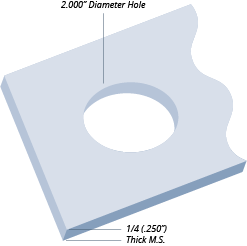
Example:
2” Diameter Round Hole Through 1/4” Thick Mild Steel:
Force = 𝛑(3.1416) x 2.0 (Diameter) x 0.25 (Thickness) x 25 (Material tensile strength) = ~39.26 Tons
Force Required for Punching a Shape
Equation:
F=L∗t∗(UTS)
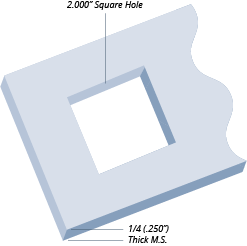
Example:
2” Square Through 1/4” Thick Mild Steel
Force= (2 + 2 + 2 + 2) Shape Periphery x 0.25 (Material Thickness) x 25 (Material tensile strength) = 50 Tons
*These are theoretical examples and for reference only. True measurement will depend on your press speed, tooling and other conditions. Please consult us for specific information when using Air-Hydraulics presses.
Design
Presses can be designed in many different ways. Which of these is best for your applications depends on the parts or workpieces you’re using, as well as the surrounding processes, and the available space in your work area. Consider these different designs:
- C-frame: A C-frame press resembles a C-shape, with the ram positioned in the open part of the C. Workers can move around this design more easily than some other designs.
- 2- or 4-post: These presses stand on 2 or 4 columns, with the ram positioned in the middle. These types of presses can have more stability, but more limited movement around the press.
- Benchtop: A benchtop press sits on a table or bench. These presses have a much smaller footprint, but they work best with smaller workpieces or with other benchtop units.
Features
The features you select for your press or impact hammer can give you additional functionality, make the process faster and easier, and more efficient. Here are a few features you might add to your press to optimize performance and production.
- Automation: Automation integrations can free workers to take on more important tasks, and improve production speed significantly.
- Rotary indexing: Rotary indexing allows the workpiece to move and rotate as needed, so the machine can perform different actions quickly.
- Force and/or distance monitoring: Force monitoring, distance monitoring, or both together can record and manage the activity of the press, ensuring that it completes its cycle properly, and alerting workers about maintenance needs or other issues. This could help identify any drop-offs during the punching process when used with certain presses, but would not provide valuable insight for impact hammers.
Talk with a press expert to get the best press for your punching applications. To learn more about press designs, force, features, and more, contact us today.