
Power hammers are important tools in manufacturing and assembly processes, known for their ability to deliver instantaneous impact. Power hammers are often used for tasks such as shaping metal, forging parts, and riveting, which makes them a staple in various industries. Let’s take a closer look at what power hammers are, how they work, and their different power hammer uses in manufacturing and assembly.
What is a Power Hammer?
First, what is a power hammer? A power hammer, sometimes referred to as an impact hammer or mechanical hammer, is a type of manufacturing and metal forging machine that uses kinetic energy and controlled force to shape, compress, or join materials. Impact hammers consist of a frame, a reciprocating hammer head, and an anvil. They rely on repetitive, high-impact strikes to manipulate materials effectively. In simple terms, a power hammer is essentially a more complex version of a traditional hand hammer, with much higher efficiency, precision, and strength for industrial applications.
How Does a Power Hammer Work?
The basic mechanism of a power hammer revolves around converting energy into impact force. This is typically achieved through a motor-driven system, which might use mechanical, pneumatic, hydraulic or electric power to drive the hammer head (we’ll discuss this in more detail in the next section). When activated, the machine delivers a series of rapid, controlled strikes onto the workpiece positioned on the anvil. The repeated impacts make power hammers ideal for shaping, compressing, or breaking down materials into desired forms.
Types of Power Hammers
Power hammers come in various designs, each tailored for specific industrial needs. Here are some common types:
- Mechanical Power Hammers
- Operate using a flywheel and crankshaft mechanism.
- Known for their reliability and simplicity.
- Ideal for forging and shaping heavy-duty materials.
- Pneumatic Power Hammers
- Powered by compressed air, offering more control and precision.
- Popular in industries that require detailed shaping and finishing work.
- Quieter compared to mechanical hammers
- Hydraulic Power Hammers
- Use hydraulic systems to deliver powerful, steady impacts.
- Provide exceptional force, ideal for heavy forging and forming.
- Known for their durability and ability to handle continuous operations.
- Electric Power Hammers
- Utilize electric motors for energy-efficient performance.
- Common in modern manufacturing setups where automation is key.
- Easy to integrate with CNC systems for enhanced productivity.
Each type has specific models tailored for different tasks. For example, the Black & Webster Electropunch from Air-Hydraulics delivers between 3,500 to 15,000 lbs. of instantaneous force, which makes it suitable for light or heavy jobs. Our Z Series Impact Hammer delivers between 6 to 20 tons of force, and uses shop air as a pneumatic power source, reducing energy costs significantly compared to hydraulic or electric models.
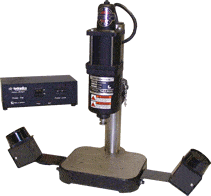
Black and Webster Electropunch
Applications: Assembly, Riveting, Marking, Staking, Swaging
Models: Model C, Model FJS, Model BS, Model SMS, Model JS
- 3500-15000 lbs. Impact Force
- Fully Electric Operated Unit Ideal for Light Taps to Heavy Impacts
- Instantaneous Impact
- The Model C and the Model FJS are mounted in a rugged cast iron frame
- Model BS and SMS are mounted on a column in which daylight opening can be adjusted
- 1.75″/2.0″ Overall Stroke
- Two Hand Non-Tie Down Actuators or Footswitch with Safetyswitch Operation
- Bench Type Units

Z-Series Impact Hammer
Applications: Stamping, Forging, Coining, Riveting, Staking, Forming, Trimming
Models: 6 Ton Impact Hammer, 20 Ton Impact Hammer
- 6 to 20 Tons of Impact Force
- Utilizes Shop Air as a Clean and more Energy Efficient Power Source
- Features an adjustable daylight or working height opening
- Constant Stroke
- 4″ Overall Stroke
- Two-Hand Non-Tie Down Control Actuators
- Available in Benchtop or Mounted Models
Power Hammers vs. Industrial Presses
You may have noticed that there are several similarities between power hammers and other types of industrial presses. While there is significant overlap—both power hammers and industrial presses are used to shape, compress, or join materials—their mechanisms and applications differ. A power hammer uses repeated, high-impact strikes to manipulate materials, making it ideal for tasks like forging or riveting.
An industrial press, on the other hand, generally applies force in a more continuous manner to achieve deformation or bonding, often in a single motion. Presses are better suited for tasks like stamping, molding, and punching, where uniformity and high force over a larger area are required. Power hammers excel in dynamic, high-speed applications, like staking and crimping, while presses are preferred for controlled, deliberate shaping and assembly processes.
Power Hammer Uses in Manufacturing and Assembly
Power hammers are versatile machines with applications across various industries. Their ability to apply precise, repetitive force makes them invaluable for several manufacturing and assembly tasks, including:
- Metal Forging: Shaping raw metal into specific forms for tools, automotive parts, and industrial components.
- Riveting: Securing metal components together by driving rivets into pre-drilled holes.
- Flattening and Drawing: Reducing material thickness and extending length for specific applications.
- Character Stamping and Embossing: Using dies or punches to embed identifying marks or decorative patterns into metal surfaces.
- Destructive Testing: Using a power hammer to break down metal samples into smaller sections for material analysis and evaluation.
In addition to these tasks, power hammers play a critical role in manufacturing heavy machinery, structural steel components, and even aerospace parts. Their efficiency in handling tough materials ensures they remain a staple in industries where precision and durability are paramount.
Power hammers are powerful, versatile tools that streamline many different manufacturing and assembly processes. By understanding the different types of power hammers and their optimal applications, manufacturers can choose the right model to enhance productivity and meet their overall goals. If you have questions about power hammers or industrial presses, we can help. Contact us to learn more about each of these machines and their many different models and customization options.