
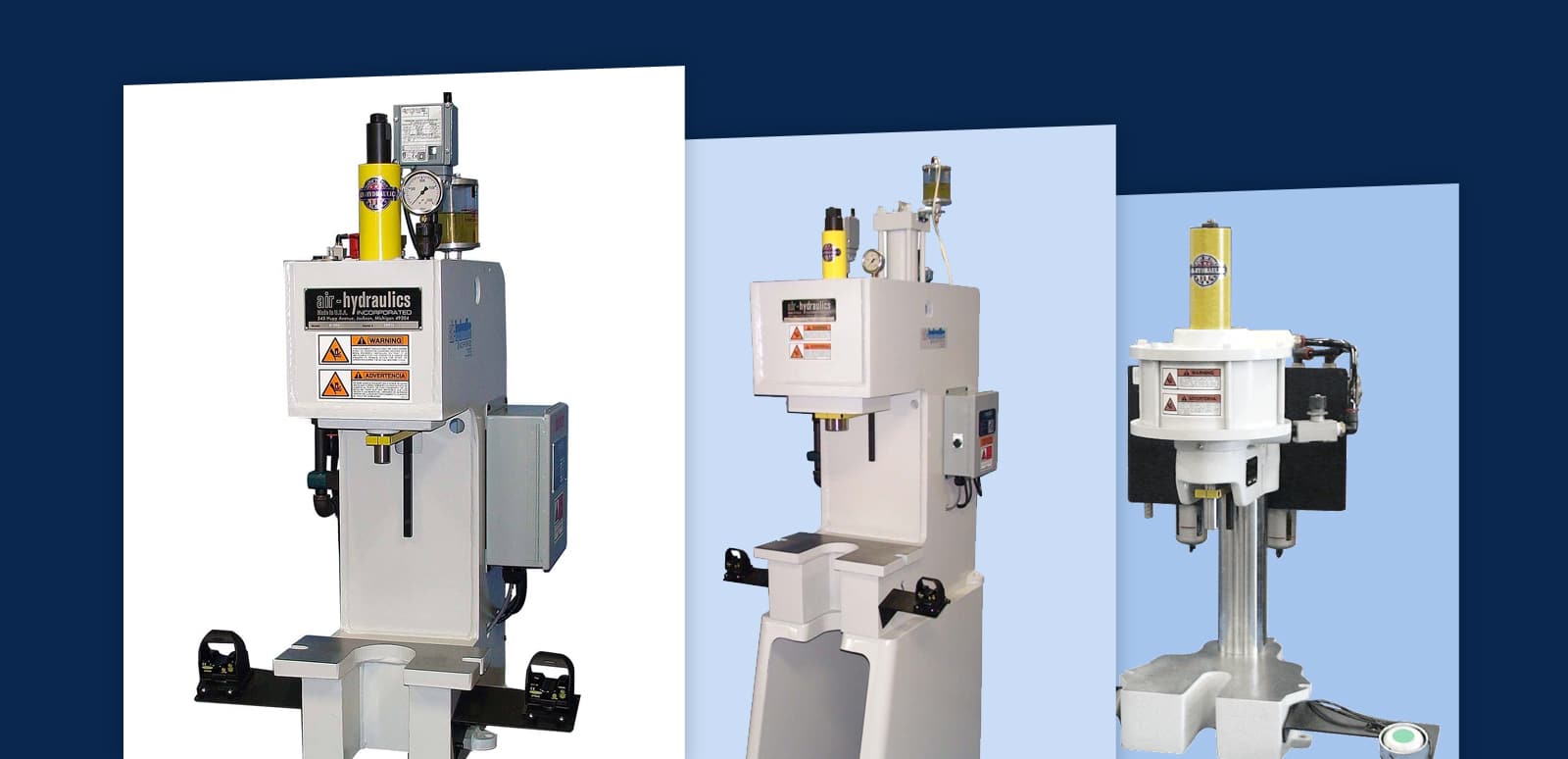
In many industrial settings, clamping and holding are often treated as simple, static steps in a process. Most people picture hand-operated vises, toggle clamps, or pneumatic grippers when they think of holding components in place. But in many high-volume manufacturing environments, especially those involving automation or complex assembly, a press is a more effective solution. Let’s take a look at some of the best presses for clamping and holding applications.
Why Use a Press for Clamping and Holding?
There are several reasons manufacturers might use presses instead of traditional clamps or similar tools to secure a part in place. First and foremost is force control. A press can deliver consistent, controllable force throughout the entire cycle—something a clamp simply can’t do without constant adjustment. For processes like thermal bonding or ultrasonic welding, that consistent force can make or break product quality.
Second is repeatability. Presses, especially when integrated with sensors and force monitoring technology, ensure the same force and dwell time every cycle. This precision reduces scrap, improves reliability, and allows easy integration with quality assurance systems.
Presses also enable automation. In a robotic cell or automated line, a press can be controlled digitally, synced with other equipment, and used to verify that parts are in the correct position and orientation.
Wondering about the best press for your application?
Get in touch >
The Best Presses for Clamping and Holding
Clamping and holding are rarely the end goal. They’re generally the start of a larger process. Whether you’re bonding, welding, staking, or pressing a component into place, the part needs to be held securely and precisely. A clamp might do the job on a workbench, but in production environments where force, repeatability, and speed matter, a press can make your entire process more efficient. Choosing the right press for your clamping and holding application can help to ensure that your press synchronizes with your other equipment, and that the process is quick, accurate, and secure.
Pneumatic Presses: Fast and Efficient for Light Holding
Pneumatic presses are a popular choice for clamping tasks that require moderate force and high speed. These presses operate using compressed air and are known for their quick action and relatively low cost. In applications like staking plastic parts, holding components during ultrasonic welding, or providing a clamping force during secondary operations, such as leak testing or assembly, pneumatic presses offer plenty of clamping force without overcomplicating the setup.
One major advantage of pneumatic presses is their ease of maintenance. With fewer moving parts than hydraulic systems and simple integration into existing air supplies, they’re a great choice for light-duty holding in semi- or fully-automated workstations.
Hydraulic Presses: Heavy-Duty Holding for Demanding Tasks
When the job requires serious holding force (>50 tons), a hydraulic press is often the best option. These machines use hydraulic fluid to generate high tonnage, making them ideal for metal forming, die pressing, and other applications that involve heavy components or significant deformation.
Hydraulic presses are especially useful for long dwell times; holding a component under pressure for an extended period without losing clamping force. This is important for operations like bonding large components, laminating, or deep forming processes. While they require more infrastructure and maintenance than pneumatic presses, their raw force and durability make them a crucial tool in heavy manufacturing.
Hydropneumatic Presses: A Smart Middle Ground
Hydropneumatic presses, also known as air-over-oil presses, combine the speed of pneumatic systems with the force of hydraulic ones. They use compressed air to move a piston quickly during approach, and then oil pressure to deliver high clamping force during the final stroke. This hybrid approach gives manufacturers the best of both worlds: fast cycle times and reliable force control.
These presses are ideal for applications like press-fitting, staking, or bonding where moderate to high force is needed, but full hydraulic systems might be overkill. They’re also more energy-efficient than pure hydraulics, as they only use energy during a press cycle. Many hydropneumatic presses are compatible with force and distance monitoring systems, making them suitable for error-proofing and data capture in modern assembly lines.
Presses for Clamping and Holding
When your process demands more than just “holding things in place,” it’s time to think beyond traditional clamps. Whether you’re assembling delicate components or managing high-force bonding operations, the right press can deliver consistency, speed, and integration that clamps can’t. For manufacturers aiming to scale efficiently and maintain high product quality, a press is more than a tool—it’s a process upgrade. Looking to upgrade your clamping and holding processes? Contact us today to find the right press solution for your operation.