

The right data can help you better assess your processes and make improvements. From reducing defects to improving process speed to improving product quality and more, data plays a key role in improving efficiency. Let’s compare two different press technologies with data-gathering capabilities; force and distance monitoring and electric servo presses.
What is Force and Distance Monitoring in Factory Presses?
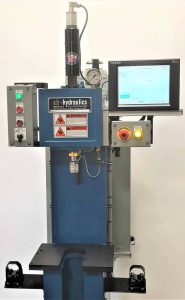
Force and distance monitoring in factory presses is a sophisticated system using various sensors designed to enhance monitoring during manufacturing processes. This technology involves real-time measurement and analysis of the force applied and the distance traveled during each press operation. The most common forms of monitoring are a compression load cell attached to the press ram and a linear position transducer used to measure the distance traveled by the cylinder rod during the stroke. These devices transmit their signals, typically voltage or current, to factory automation devices such as digital readouts, HMI’s, and other computer like systems which have more sophistication such as pass-fail criteria, waveforms, etc.
By capturing these parameters & values, manufacturers gain valuable insights into the assembly process, enabling them to verify that each cycle meets the required process criteria specific for each application. This data can also help identify and address press issues promptly, optimize processes, and ensure the production of high-quality components while minimizing product defects and field failures.
The SIG Series Air-Over-Oil press tracks and records essential data to optimize quality control and prevent defects
Learn more >
Stand-Alone Force Monitoring
Stand-alone force monitoring is a subset of force and distance monitoring, focusing exclusively on measuring the force exerted during a press operation. This technology provides essential data for quality control and process optimization. By monitoring force independently, manufacturers can detect anomalies, prevent defects, and maintain consistent product quality where only force requirements need to be met. This focused approach is particularly beneficial for applications where the peak force is the only parameter that is needed for process verification.
What is a Servo Electric Press?
A servo electric press is an electric actuator driven by a servo motor, revolutionizing traditional press operations. Unlike conventional hydraulic or mechanical presses, a servo press uses a motor attached to a screw style linear actuator that converts the rotary motion of the motor to linear motion exerted by the actuator. The motor has an encoder which provides positional feedback to the control system. This setup enables precise control over crucial parameters such as force, speed, and stroke length, providing a high level of accuracy and repeatability in the manufacturing process.
The programmable nature of the servo press allows for dynamic adjustments, accommodating various production requirements with ease. This level of control not only enhances the precision of each press operation, but also offers flexibility in adapting to diverse applications. The servo electric press helps manufacturers achieve optimal performance, improved quality, and greater adaptability in modern industrial settings.
Force and Distance Monitoring vs. Servo Electric Presses: Which is Best?
Force and Distance Monitoring
Advantages
- Accurate, with real-time pass/fail feedback
- Can be integrated with pneumatic, air over oil, and hydraulic presses
- Ideal for quality control & monitoring across various pressing parameters
- Includes data acquisition capability
- Economical maintenance and repair costs
Disadvantages
- Higher investment cost compared to standard press ($$)
- Only monitors the assembly process
- Cannot fully control the action of pressing process
Complete press monitoring of the assembly process
Servo Electric Presses
Advantages
- Highly accurate, with real-time pass/fail feedback
- All electric operation – no hydraulic fluid or air connection needed
- Ideal for quality control, monitoring, and compete process control
- Includes data acquisition capability
- Complete press control and monitoring of the assembly process
Disadvantages
- Higher investment cost compared to a standard press ($$$$)
- Relies on high voltage energy supply
- Actuator needs to be configured to the particular application for the intended use
- More complex control system
- Expensive repair costs
To compare force and distance monitoring with servo electric presses, it’s helpful to evaluate their strengths and weaknesses. Force and distance monitoring excels in providing detailed insights into each pressing operation, enabling precise data monitoring and defect prevention. However, their standalone focus may limit overall press functionality. On the other hand, servo electric presses offer dynamic control over force, speed, and stroke length, providing versatility in manufacturing processes. However, servo electric presses are also more expensive, and these devices might not produce ROI for simpler operations.
Which option might work best for you depends on specific application requirements. Force and distance monitoring excels in many quality control situations, with the ability to visualize that the pressing cycle was completed within the pass-fail parameters. Servo electric presses offer adaptability for a broader range of manufacturing needs, and provide more flexibility and precise control. Considerations such as costs, the data collected, and functionality should guide the decision-making process to ensure optimal performance and return on investment.
To learn more about force and distance monitoring, force monitoring alone, or servo electric presses, contact us. We’re happy to help you find the right press and features for your needs and applications.