How to Find the Best Benchtop Pneumatic Press

Choosing the best benchtop pneumatic press is essential for businesses looking to enhance efficiency, precision, and reliability in their manufacturing or assembly operations. These compact, yet powerful tools are designed to deliver consistent force while minimizing energy use, making them a practical choice for a wide range of applications. Let’s take a closer look at benchtop pneumatic presses, including what a pneumatic press is in general, how it differs from other industrial presses, and the key features to consider when selecting the best benchtop pneumatic press for your needs.

What is a Pneumatic Press?

First, what is a pneumatic press, and how does it differ from other types of benchtop presses? Understanding the differences can help ensure that a pneumatic press is the right fit for your job, and determine which type of benchtop pneumatic press will be ideal.

A pneumatic press, also called an air press, is an industrial machine that uses compressed air to generate force for tasks such as pressing, stamping, crimping, or forming materials. Unlike hydraulic presses, which rely on compressed liquid, or mechanical presses, which use mechanical energy, pneumatic presses operate using air pressure supplied by a compressor or a shop air system. This design makes pneumatic presses simpler to operate and maintain while offering a cleaner, quieter alternative to hydraulic systems.  Pneumatic presses also offer higher accuracy, improved repeatability, and virtually no operator strain compared to manual or arbor press options.

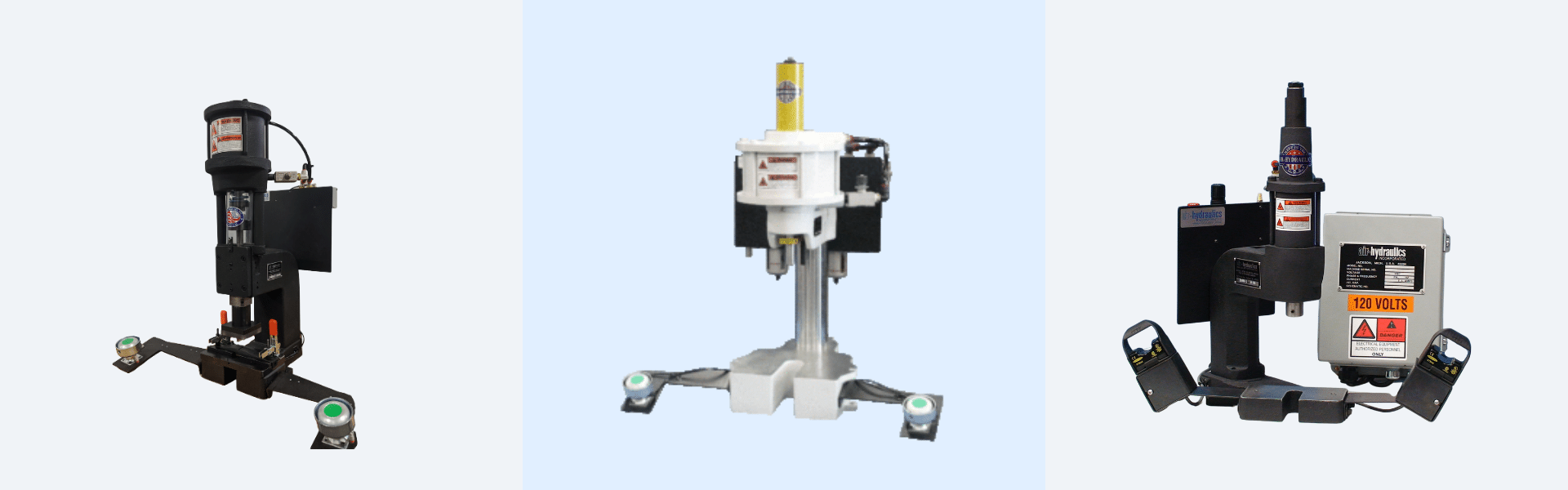
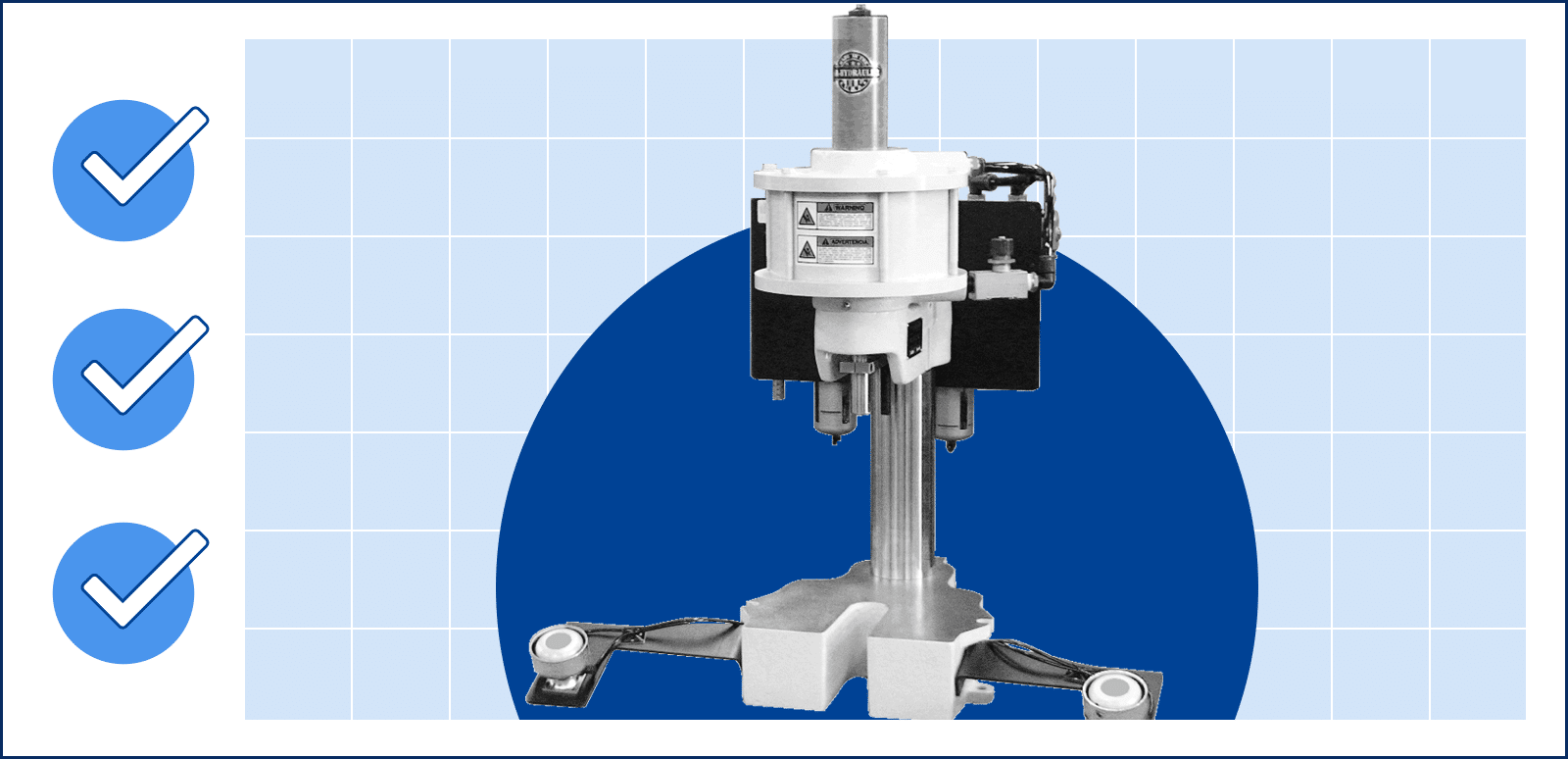
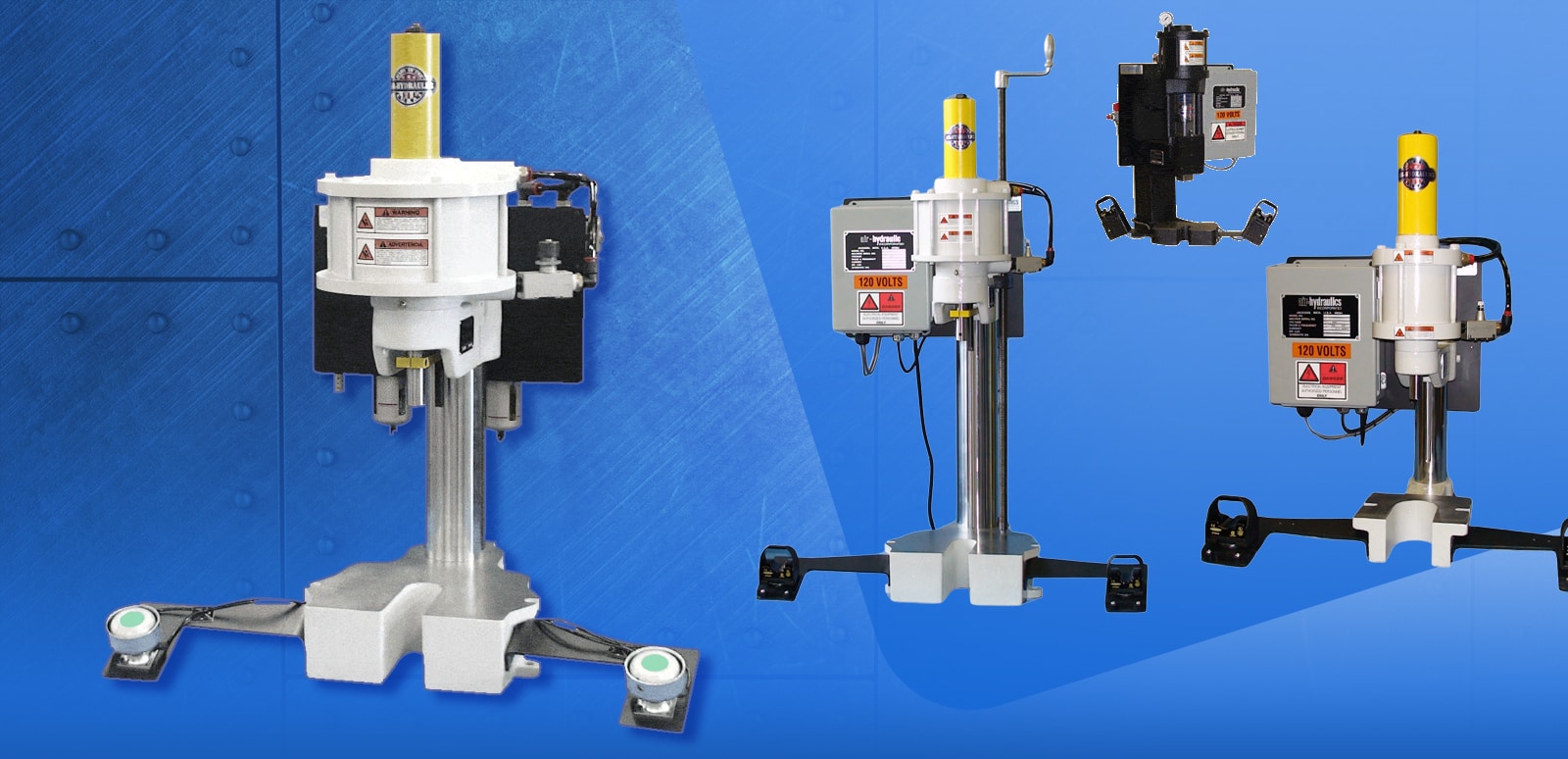
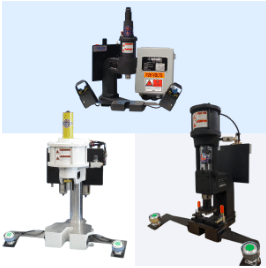
The AP-Series Air Press features a compact, robust frame that has minimal deflection for those small precise application projects. It also does not require lubricated air, which makes it a great choice for clean room environments.

AP 1900

Whereas, our A-Series Adjustable Air Press offers flexibility by featuring an easy full head cylinder adjustment design, which is ideal for die-set applications and for changeover between applications.

A Series Press

How Are Pneumatic Presses Different?

Pneumatic presses, hydraulic presses, mechanical presses, and hydropneumatic presses share some similarities, but there are also important differences. The primary difference between pneumatic presses and other industrial presses lies in their power source and operational efficiency.

Pneumatic presses utilize compressed air pressure, making them lighter, faster, and more energy-efficient than hydraulic presses, which require complex fluid systems. Hydraulic systems also require more complex maintenance to prevent issues and ensure they’re working properly, while the maintenance for pneumatic systems is typically much simpler. Pneumatic systems are also easier to install, as they often connect directly to a standard shop air supply. Unlike mechanical presses, which deliver force through flywheels and cranks, pneumatic presses provide more precise control over force application, reduce operator strain compared to manually operated presses and ensure repeatability.

Applications for Pneumatic Presses

Though many pneumatic presses can generate several tons of force, most provide a moderate level of force. Common uses include:

  • Assembly Operations: Press-fitting, staking, and riveting components.
  • Manufacturing Processes: Punching, embossing, and light metalworking.
  • Electronics Assembly: Handling delicate tasks like pressing sensitive components.
  • Clamping Operations: Press and hold operations where pressure needs to be maintained to clamp the part or assembly so secondary operations can be performed (eg. leak/pressure testing)
  • Plastic Forming: Shaping and sealing plastic parts.

Their versatility and precision make pneumatic presses a popular choice in industries such as electronics, automotive, and packaging.

Advantages of Pneumatic Presses

Pneumatic presses offer several advantages that make them a go-to solution for many businesses:

  1. Energy Efficiency: By utilizing shop air, pneumatic presses require less energy compared to hydraulic presses, which require energy-intensive pumps and fluid systems. Air presses also only consume shop air when in use, which cuts down on overall energy use altogether.
  2. Compact Design: Their simple construction often results in a smaller footprint, making them perfect for benchtop applications.
  3. Ease of Maintenance: Pneumatic systems are easier to maintain than hydraulic systems, which involve fluids and seals prone to leaks.
  4. Precision and Control: The ability to adjust air pressure and cylinder rod speed allows for fine control over the force applied, enhancing accuracy for delicate or small-scale operations. Double Rod End Cylinders also provide a mechanical method to prevent over-travel of the cylinder rod.

What to Look for in a Benchtop Pneumatic Press

A benchtop pneumatic press can be a great addition to your workplace. However, it can be difficult to get the right model, since there are many different types and customizations to choose from. When selecting the best benchtop pneumatic press for your needs, consider the following factors:

  1. Force Capacity
    It’s important to consider how much force the press can generate, as well as how much force your job requires. Benchtop pneumatic presses can provide hundreds or thousands of pounds of force. However, it can be difficult to generate multiple tons of force. Matching the force capacity to the requirements of your materials and applications will ensure that you’re not paying more for energy than you need to, while also ensuring that your press can easily finish the job. It’s recommended to size your pneumatic air press so that your pressing application requires no more than 75% of the press’ force capacity.
  2. Dimensions and Footprint
    Ensure the press fits comfortably on your benchtop and leaves enough space for operators to work around it. Compact presses are ideal for smaller workstations, but larger models may offer additional capabilities for more demanding tasks.
  3. Adjustability
    Look for presses that can be easily adjusted to accommodate different workpieces. Features such as adjustable stroke length, die height, and pressure settings are crucial for versatility and precision.
  4. Durability and Build Quality
    Consider your working conditions, and the requirements for your press’s durability. A press with a long lifetime will be made from high-quality materials, and it will be able to withstand repetitive use and heavy loads. Steel frames and components are ideal for long-term reliability. It might also be important to consider surrounding conditions, such as humidity, dust, or moisture.
  5. Ease of Integration
    If the press will be part of an automated production line, ensure it can integrate with your existing systems. Pneumatic presses compatible with PLCs (programmable logic controllers) or other automation tools, like sensors and monitoring devices, can significantly enhance productivity.
  6. Safety Features
    Safety mechanisms such as two-handed operation, emergency stop buttons, and guards can help protect workers and enable more efficient operation. Other safety features, like light curtains or interlocking doors can also help make your pneumatic press safer and easier to use, depending on your application.

Additional Considerations

  • Noise Levels: While pneumatic presses are quieter than hydraulic ones, consider models designed to minimize operational noise further.
  • Cost and Value: Compare prices across models, but prioritize value over cost. A higher-priced press with better durability and features may save you money in the long run.
  • Manufacturer Support: Choose a press from a reputable manufacturer that offers warranties, training, and after-sales support.

Benchtop pneumatic presses offer a powerful and compact solution for many manufacturing and assembly operations, excelling in energy efficiency, precision, and versatility. By understanding their unique advantages and carefully evaluating factors like force capacity, footprint, and adjustability, you can find the best benchtop pneumatic press to suit your needs. If you have questions about benchtop pneumatic presses, or other types of presses for manufacturing and assembly, we can help. Contact us today to get your questions answered.
Air-Powered Presses for Production and Assembly

air-powered presses for production and assembly

Air-powered presses, including pneumatic presses and hydropneumatic presses, are commonly used for production and assembly applications in factories. They rely on compressed air to generate the force needed to carry out tasks like punching, stamping, bending, forming, and assembly. Air presses are popular for their simplicity, speed, and cost-effectiveness. Let’s take a closer look at air-powered presses for production and assembly, including how they work, their ideal applications, and their advantages.

How Do Air-Powered Presses Work?

A pneumatic press uses the power of compressed air to perform industrial tasks. The process starts with an air compressor that generates and stores compressed air at a set pressure. A series of control valves regulate the flow and timing of air entering the press’s pneumatic cylinder. When the operator activates the press, either through a manual switch or an automated system, the control valves shift, allowing compressed air to enter the cylinder and push against a piston.

As the compressed air pushes the piston downward, it moves the ram toward the workpiece. This ram applies the force needed to perform the pressing action, whether it’s punching a hole, bending metal, or assembling parts. The force generated by the press is determined by the air pressure and the size of the pneumatic cylinder.

Once the pressing task is complete, the control valve changes the direction of the air or releases it. This change in air direction or drop in pressure causes the piston and ram to retract to their starting positions, either aided by return springs or by air pressure applied to the opposite side of the piston. The press is then ready for another cycle, allowing for quick, repetitive operations with minimal downtime.

The simplicity and speed make pneumatic presses an efficient choice for many factory assembly and production tasks, especially where precision and heavy force are not the primary requirements.

air press options

AHI Industrial Air Presses 

Air-Hydraulics offers two lines of pneumatic air presses for industrial production and assembly applications.

Each press model can be fully customized with specific controls, safety features or automations to meet your applications needs and requirements.

Hydropneumatic Presses: Air-Over-Oil

A hydropneumatic press, also known as an air-over-oil press, combines both pneumatic and hydraulic systems to deliver power with efficiency. Much like in a standard pneumatic press, the process behind a hydropneumatic press also begins with compressed air. The compressed air enters the pneumatic cylinder and pushes a piston downward, displacing the self-contained hydraulic fluid on the output piston rod. This allows for a low-force, quick approach to the workpiece which generates quicker cycle times while being energy efficient.

Once the press ram reaches the workpiece, the second stage of the process begins. The compressed air is then directed into another air cylinder chamber, which advances the internal hydraulic pressure piston and rod into the self-contained hydraulic fluid, intensifying pressure onto the output piston rod. This amplifies the force significantly, allowing the cylinder to exert the required force on the workpiece. In this way, hydropneumatic presses are ideal for tasks requiring both speed and power, such as metal forming, punching, or assembly operations involving dense materials.

Applications of Air-Powered Presses

Though air presses can deliver a great deal of force, most air presses do not exert as much force as hydraulic presses. Hydropneumatic presses can exert more power than purely pneumatic presses due to the internal hydraulic intensification. This makes it possible for air presses and air-over-oil to accomplish a wide variety of applications.

Industrial air presses are widely used in assembling car parts, such as pressing bearings or assembling electrical connectors. Air presses are also commonly used in electronics manufacturing, since they can be lightweight, fast, and clean. They may also be used in packaging lines to seal, clamp, or assemble components quickly, or in plastic part assembly or forming.

The following are a few common examples of air powered presses in product and assembly operations:

  • Press-Fitting: Inserting or pressing components into place, such as bearings, bushings, or fasteners in automotive and electronic assembly.
  • Riveting and Crimping: Joining materials, such as riveting sheet metal or crimping electrical connectors.
  • Punching and Stamping: Creating holes or shaping materials, especially in lighter materials like sheet metal, plastic, or rubber.
  • Bending and Forming: Manipulating materials into the desired shape, especially for materials like sheet metal or softer materials.
  • Sealing and Clamping: Joining materials together by folding or pressing, especially for packaging or clamping components together.

Advantages and Disadvantages of Air Presses in Factory Settings

There are a variety of advantages of air presses, including pneumatic and hydropneumatic presses. There are also some disadvantages that make them unsuitable for some operations. Let’s take a closer look at each.

Advantages:

  • Simplicity and Low Maintenance: Both pneumatic and hydropneumatic systems are relatively simple and have fewer moving parts compared to hydraulic systems. This reduces the amount of maintenance required.
  • Energy Efficiency: Air presses consume less energy than hydraulic presses, since they don’t require a continuously running pump like hydraulic systems. This makes them efficient for high-cycle, intermittent operations.
  • Clean Operation: Since they don’t use oil or fluids, pneumatic presses are clean and well-suited for environments where cleanliness is important (e.g., food production, electronics).
  • Safety: Pneumatic systems tend to be safer than hydraulic ones, since hydraulic fluid leaks can be hazardous and air pressure can be more easily controlled.

Disadvantages

  • Limited Force Control: Pneumatic presses offer less fine control over the applied force compared to hydraulic systems. This makes them less suited for precision applications requiring consistent force throughout the stroke.
  • Less Power for Heavy-Duty Tasks: Pneumatic presses are better suited for lighter materials and operations, but are generally not as powerful as hydraulic presses for tasks requiring extreme force.
  • Air Availability: Air presses and air-over-oil presses require a source of compressed air, which may be difficult in some environments.

Pneumatic and hydropneumatic presses are highly versatile tools for production and assembly, providing excellent speed, simplicity, and cost-effectiveness, especially for light- to medium-duty tasks in factory settings. If you are interested in an air press and wondering about additional features or optimal applications, we can help. Contact us today to learn more about pneumatic or hydropneumatic presses.

Interested in an Air-Powered Press for your next assembly project?

Provide details on the project applications and we can work up a custom quote for an air-powered press to deliver the required force with the efficiency of pneumatic power.

The Complete Guide to Air Press Maintenance

air press maintenance guide

Maintaining your air press is essential for ensuring its longevity, efficiency, and safety. Regular maintenance helps prevent unexpected breakdowns, reduces overall downtime, and saves on costly repairs. In this guide, let’s take a look at the important steps involved in air press maintenance.

The Complete Guide to Air Press Maintenance

There are many advantages to air presses. Compared to hydraulic presses, air presses often are less expensive to purchase, easier to maintain, have smaller footprints, and more. Performing regular maintenance will help you take advantage of these advantages, and keep your press in top working order.

Interested in a new air press?

Learn more about AHI air presses and technologies ›

Lock-Out, Tag-Out

Before beginning any maintenance, it’s critical to follow lock-out, tag-out (LOTO) procedures. LOTO procedures require disconnecting and locking the power source to prevent accidental startup during maintenance. Tagging the machine with a visible warning ensures everyone knows the equipment is being serviced. Adhering to LOTO procedures protects you and your colleagues from serious injury.

Drain Water From Air Supply

All air contains some amount of water vapor. This water vapor will condense into liquid water in the compressed air system when the air cools past the saturation point. Moisture in the air supply can cause significant damage to the air press. Regularly draining the water from the air compressor and air lines prevents rust, corrosion, and operational issues. This step is especially important in humid environments where moisture buildup is more common. Ensure all water traps are emptied and check for any signs of excessive moisture in the system.

Change Air Filter

The air filter is an especially important element in air press maintenance. It prevents dust, debris, and other contaminants from entering the air press. Over time, the filter can become clogged, reducing airflow and efficiency. Replacing the air filter at regular intervals ensures clean air supply, optimal performance, and prevents damage to internal components. Usually, air filters should be replaced about every 6 to 12 months, though this might be more frequent in especially dirty environments. Always use the manufacturer-recommended filter for best results.

Lubrication (If required)

If your air press requires lubrication, proper lubrication is vital for reducing friction and wear on moving parts. Regularly check and refill lubricants according to the manufacturer’s specifications. Keep in mind that different components may require different types and levels of lubricants, so make sure that you’re using the correct type of lubricant for each part. Proper lubrication extends the life of your air press and maintains smooth operation.

Replace Seals and Wear Parts

Seals and other wear parts degrade over time, leading to leaks and inefficiencies. The US Department of Energy states that air leaks around seals or other wear parts can waste as much as 20 to 30% of the air compressor’s output. Regularly inspect these components and replace them as needed to maintain the air press’s integrity. Keeping a stock of commonly used seals and wear parts can minimize downtime and ensure quick repairs when necessary. This will not only help the press maintain its smooth functionality, but it will also help the press operate with great efficiency.

Have an AHI Air Press? Contact us for information on recommended filters or replacement seals and other wear parts for our A-Series or AP-Series Air Presses.

Inspect Tubing

Tubing in the air press system can also develop cracks, leaks, or other damage over time. Regularly inspect all tubing for signs of wear and tear. Replace any damaged sections promptly to prevent air leaks and maintain system pressure. Properly functioning tubing is essential for the efficient operation of the air press.

Check and Adjust System Pressure

Operating your air press at the correct pressure is important for both performance and safety. Regularly check and adjust the system pressure according to the manufacturer’s specifications. If the system pressure is too high or too low, it can cause damage and reduce efficiency or cause non-conforming assemblies. Ensure the pressure settings are appropriate and correct for the tasks at hand. If the system pressure or force is not correct, consider checking or replacing the seals in the cylinder.

Safety Mechanisms

Safety mechanisms, such as pressure check valves and emergency stop buttons, must be in good working condition. Regularly test these mechanisms to ensure they function correctly in case of an emergency. It’s also important to examine additional safety mechanisms, such as light curtains, and make sure they’re in full working order. Properly working safety mechanisms protect operators and prevent equipment damage.

Clean Working Area

A clean working area is essential for safe and efficient maintenance. Keep the area around the air press free of debris, oil spills, and other hazards. A tidy workspace reduces the risk of accidents and makes it easier to use the press and perform air press maintenance tasks effectively.

Cycle Testing

After performing maintenance, it’s important to run cycle tests to ensure everything is functioning correctly. Cycle testing involves operating the air press through a complete cycle to check for any issues. This step helps identify problems before they become serious and ensures the air press is ready for use.


Air-Hydraulics offers two lines and six models of industrial air presses for a variety of manufacturing and assembly applications. View Air Press Options ›


Regular maintenance of your air press is essential for ensuring its longevity and optimal performance. By following this complete guide to air press maintenance, you can keep your equipment in top condition, reduce the risk of unexpected breakdowns, and maintain a safe working environment. If your air press isn’t working like it used to, or you want to upgrade your press, we can help. Contact us today to learn more about air press or air-over-oil press options.


How to Choose the Best Industrial Pneumatic Press

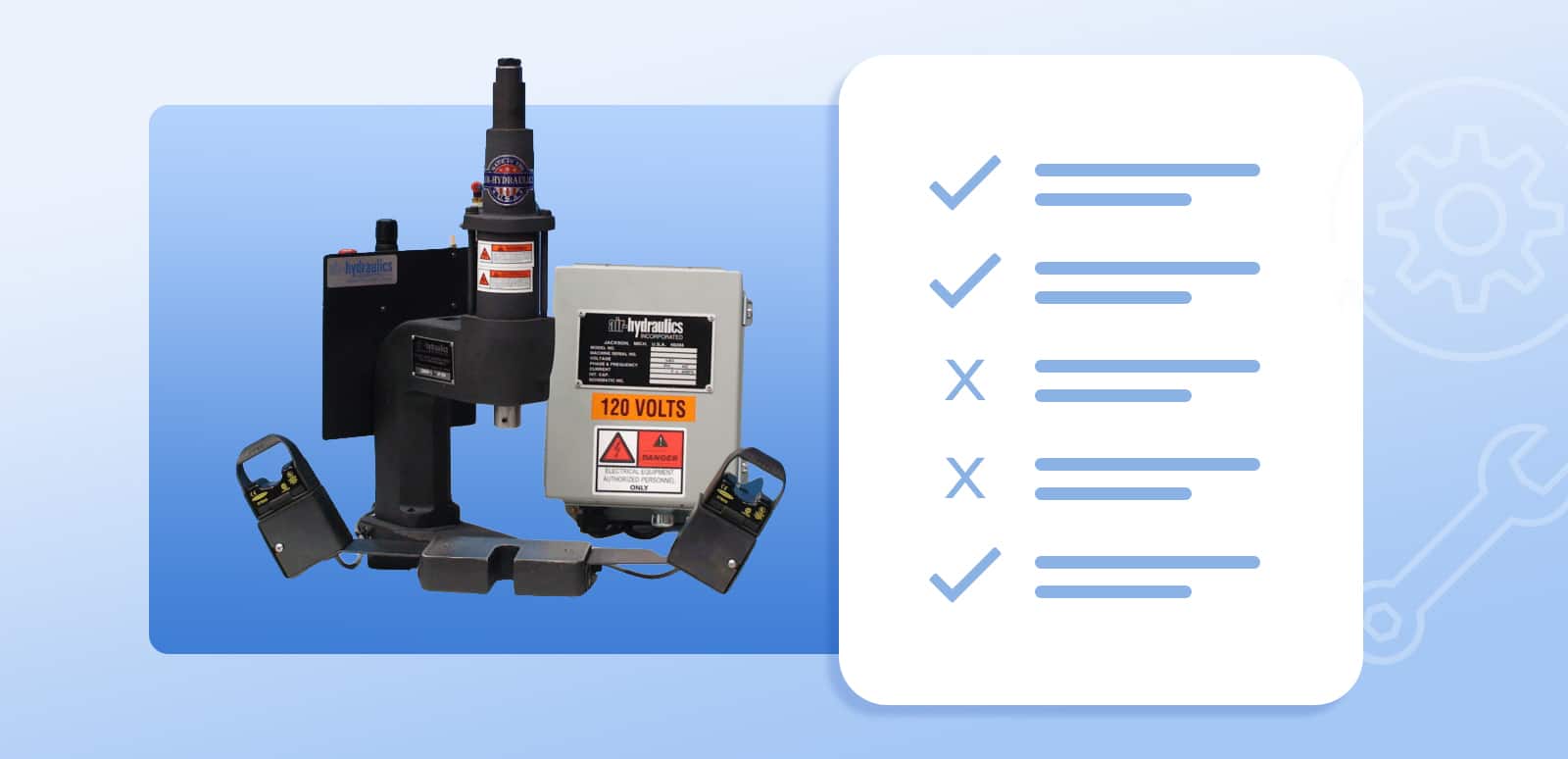
Pneumatic presses can be used in a variety of manufacturing and assembly processes. These types of presses are relatively energy-efficient and space-efficient, while also providing a high level of force. Choosing the right industrial pneumatic press can help you get the perfect fit for your process, and increase productivity and efficiency significantly. This checklist can help you find the right pneumatic press for your project or application needs.

How to Choose the Best Industrial Pneumatic Press

Process Assessment

The first step in choosing the right industrial pneumatic press is process assessment. By assessing the processes you need to complete, you’ll be able to pinpoint the specifications of your ideal press. Here are a few things to consider in your assessment:

  • Static or Adjustable: Do you need a press for one dedicated process, or do you need a press that is flexible for use in different applications and can be easily adjusted for various processes?
  • Application: Do you need your press for stamping, shearing, broaching, punching, or something else? What are the main requirements for the application: high speed or accuracy and/or consistency?
  • Speed: What would be the most efficient operational speed for the press? This might be dependent on the surrounding processes. If your press works too slowly, it will cause a bottleneck, impacting your operations down the line.
  • Materials & Tolerances: Some materials and tighter tolerances will require more force than others, so knowing your materials and part tolerances will be important for finding the right press.

Understanding the press specifications that will fit your intended application is critical to selecting the best air press model, as not all pneumatic presses are designed or function the same way.

Take for instance our two lines of air presses; the AP-Series Air Press and the A-Series Adjustable Air Press, both are designed with features that are beneficial for particular applications or facility requirements.

The AP-Series Air Press features a compact, robust frame that has minimal deflection for those small precise application projects. It also does not require lubricated air, which makes it a great choice for clean room environments.

AP 1900

Whereas, our A-Series Adjustable Air Press offers flexibility by featuring an easy full head cylinder adjustment design, which is ideal for die-set applications and for changeover between applications.

A Series Press

Quality Assessment

Once you have the press requirements determined based on your process assessment, you’ll want to choose a proven manufacturer for your pneumatic press investment. Without viewing or testing each press in person, it can be difficult to determine the best quality-to-price for a new air press. However, there are several indicators that can help you identify quality press manufacturers. First person customer reviews and testimonials are obvious places to start, when available. Case studies also give insight into product quality, options and capabilities of manufacturers and press engineers. Look for or ask about press longevity and product support available after purchase. Think about getting answers for questions like “where is the press manufactured?” and “are replacement parts and support readily available?” to ensure press maintenance will be quick and easy over down the road.

In the end, you’ll want to choose a supplier that offers the most reliable and best overall quality for your investment. Whenever possible, it’s also important to source a press domestically, with a supplier who is able to service or supply parts for your press quickly to prevent long periods of down time when maintenance is required.

75+ Years of Manufacturing Quality Press Equipment with Proven Results. View Air-Hydraulics Air Presses >

Space

Different presses can vary widely in size and shape. One of the advantages of pneumatic presses is their compact size. Choose where your press should go, and measure the space available. This might include floor space or benchtop space. Make sure you have enough clearance available for workers to move around the press comfortably and safely, as needed.

Consider the space surrounding the press as well. This might include doors, cords across the floor, fans or flying sparks, and areas where people, components, or materials frequently move though. Even the best pneumatic press won’t be effective if it’s not comfortable and safe to use.

Force Requirements

Pneumatic presses also vary widely in their force. Powerful pneumatic presses can provide thousands of pounds, and even hundreds of tons of force, which is more than enough for most jobs. Consider how much force you need for your applications; this will ensure your press performs optimally, without expending extra energy or incurring excessive costs.

Optimization

An optimized pneumatic press can save substantial energy. The US Department of Energy estimates that press efficiencies can reduce energy costs by 20 to 30%. This includes pneumatic optimizations like right-sized cylinders, reducing tubing length, improving seals, eliminating leaks, and regulating system pressure.

Additional Functions & Features

Choosing the best industrial pneumatic press means not only choosing the right press model, but also choosing the right additions and capabilities. Equipment to increase the press capabilities, like force and distance monitoring can make your press more efficient and accurate, helping to reduce defects and improve process efficiency overall. Automation can increase speed and productivity substantially. Sensors and factory monitoring devices can show when repairs or maintenance are needed, when energy expenditures are higher than normal, and much more. These, and many other equipment upgrades, can make your press stronger, faster, and more productive.

Safety Features

It’s also important to consider how the press is designed in terms of operator safety and ergonomics. If a press you are considering does not have the required or desired safety features, can they be added to the press package? Many industrial pneumatic presses can be equipped with two-hand controls (standard with all AHI air presses), barrier guarding, light curtains and other features that enhance the safety for operators and others on the factory floor. Depending on your application and factory layout, some of these features may be required.

A Series Press

We produce two lines and 7 models of customizable air presses, delivering from 150 lb. to 2.5 tons of force to meet your industrial production and assembly needs.
View Air Hydraulics Inc. Air Presses>

Arbor Press vs Air Press: Which Should You Choose?

arbor press vs air press

Finding the right press for your needs and applications can be difficult. There are many different options and configurations to choose from. Let’s take a look at the differences between an arbor press vs air press, and the situations that might be ideal for each.

Arbor Press vs Air Press: Functionality

Let’s start with the basics of an arbor press vs air press. What is an arbor press? What is an air press? How does the functionality of each one compare?

What is an Arbor Press?

arbor press example

An arbor press is a manual press that uses gears to multiply the force applied. Though arbor presses can apply up to 2 tons of force, they are often used for smaller jobs, such as staking and riveting. These types of presses generally fit on a workbench, and they’re relatively simple and easy to use.

What is an Air Press?

An air press, also called a pneumatic press, uses compressed air to drive the force behind the press. Manipulating the air pressure can change the force. Air presses can exert up to 5,000 pounds (2.5 tons), which can accommodate a wide variety of different press applications. These presses generally have more advanced features than manual options, but with a much smaller footprint compared to hydraulic presses.

examples of air presses

View Air Hydraulics Inc Air Presses, built for production  

Arbor Press vs Air Press: Advantages and Disadvantages

Arbor Press

The simple and straight-forward design of arbor presses offer a number of advantages, as well as some disadvantages. Understanding each of these can help you choose the right press for the right situation.

Advantage: Small Footprint

If your work area has limited space, an arbor press’s compact design can fit into tight spaces. Arbor presses are designed to sit on workbenches, so they don’t need dedicated floor space.

Advantage: Simple Operation

Though all presses require care and caution to operate safely, arbor presses are designed to be simple. They don’t require a lot of training to operate, and it’s possible to get started quickly.

Advantage: Affordable

The simple operation and relatively limited features of the arbor press make it an affordable option compared to other types of presses. If you’re purchasing a press for the first time, or you’re using the press infrequently, an arbor press will present faster ROI.

Disadvantage: Limited Features

The arbor press is somewhat small and easy to operate, but this can give it some limitations. Some important safety features are missing from arbor presses, and other missing features can make it difficult to take on more complex maneuvers.

Disadvantage: Limited Applications

If you end up working with larger workpieces, different materials, or different applications, your arbor press might not be able to cut it. These limited applications may slow your operation or result in low-quality results for some jobs.

Disadvantage: Limited Growth Potential

Modern presses can give you in-depth information that can make your operation faster and more efficient. The potential of arbor presses is more limited; using data-gathering features, speeding up production, and improving process efficiency generally isn’t always an option for arbor presses.

Disadvantage: Inconsistency

Arbor presses rely on manual operation, which can introduce inconsistencies. For certain applications, it is easy to see if the job has been completed correctly, but for pressing applications that require higher levels of precision, it may be difficult to determine by eye.

Disadvantage: Potential for Injury

Though easy to operate, an arbor press requires the same manual action from the operator for each and every cycle. This repetitive action, performed many times a day, can lead to repetitive stress injuries, which can become very serious and cause permanent disability.

Air Press

An air press or pneumatic press is more advanced, and these additional features can offer a number of benefits. An air press can be a great step up if you find that your manual press isn’t as effective as it used to be, or it can be a good foundational press to start with.

Advantage: Compact Design

Air presses are generally larger than arbor presses, but still present a small footprint. Pneumatic presses are designed to sit on workbenches as well, so they don’t require dedicated floor space, like hydraulic presses.

Advantage: Versatile Applications

The force and configuration of air presses is adjustable in many ways, giving them a wide array of applications. With up to 2.5 tons of force, air presses are suitable for many different assembly applications like riveting, swaging, forming, staking, marking, and other jobs.

Advantage: Easy to Maintain

Using compressed air to magnify force allows the air press to operate in a relatively clean and efficient manner. There’s no additional lubricant or oil required, such as that required for hydraulic press maintenance. Simply maintaining the machine and the air lines will keep the press operating efficiently for years to come.

Advantage: Advanced Features Available

Though they’re not mandatory, air presses can be equipped with many advanced features that aren’t available for arbor presses. These features can enable faster operation, increase safety, reduce defects, and allow operators to detect issues before they cause slow-downs or shut-downs.

Disadvantage: Investment in Factory Air

If your operation is not currently set up with factory air supply, adding a pneumatic system may require additional investment. However, this can also be seen as a growth opportunity, providing the ability to incorporate more energy efficient pneumatic presses into your press lineup.

Disadvantage: Limited Power

Air presses supply force that is equivalent to many arbor presses. However, hydropneumatic and hydraulic presses can supply much more force, with some providing hundreds of tons of force. For these types of heavy-duty applications, an air press might not be sufficient, and a hydraulic or hydropneumatic press might be ideal.

When it comes to deciding between an air press and an arbor press, understanding these advantages and disadvantages can help. If you have questions about which press would be best for your production, contact us. We’re happy to give you more information about each press available for the applications you’re working with.

Need a production air press, fit for your job or project?

Give us a few details and we will quote the best press for the application.

How to Make Your Pneumatic Press System More Efficient

how to make your pneumatic press system more efficient

Efficiency has become increasingly important across shops and factories of all sizes. Equipment with maximum efficiency not only decreases total costs of ownership, but also helps your facility reduce total energy costs. Unfortunately, many equipment manufacturers do not design with efficiency in mind. In this blog post, we’ll focus specifically on how to make your pneumatic press system more efficient.

How to Make Your Pneumatic Press System More Efficient

A few design considerations can help make your pneumatic system more efficient, while still delivering exceptional performance. Some of these considerations are ideal for those looking for a new pneumatic press, and others may be implemented as upgrades or improvements to an existing press. Whether you are optimizing the design of a new press or upgrading an existing press, making your pneumatic press system more efficient can reduce energy consumption from an estimated 20 to 35%, according to the US Department of Energy.

In this post, we’ll provide links to a few tools designed to improve the efficiency of pneumatic systems. These are only examples, and do not represent sponsorships or endorsements. Other alternatives may also be available.

Our experts design for efficiency as well as performance
Learn more about our pneumatic press systems  

Cylinder Size

Calculating the right size for the pneumatic system’s cylinder can help to improve efficiency substantially. Both undersized and oversized components can cause excessive energy use, but several tools and calculations exist to help manufacturers and their clients find the ideal size for the machine’s cylinders.

Undersizing cylinders can cause the machine to overwork to accomplish the job, while oversizing the cylinders uses more air volume and more energy than necessary with each cycle. A good rule of thumb is to add 25% additional capacity, but no more. This will ensure you have enough force to complete the operation effectively, without expending extra energy.

Correctly sizing the cylinder on your pneumatic machine can be a complicated task. The experts at Air-Hydraulics have helped many customers get the right fit for their needs. With the right-sized cylinder, you can save money on energy costs, work faster, and produce better components. If you have questions about cylinder sizing or the overall design of your pneumatic system, contact us.

Pneumatic Tubing and Seals

Another opportunity for increased efficiency has to do with your compressed air delivery across your pneumatic system, with the first place to start being the distance between your air source and machines. The shorter the distance your compressed air has to travel to your pneumatic system, the less potential there is for loss. To optimize the path between the compressor and the actuator for reduced air loss and greatest efficiency, you want to aim for the shortest tubing possible, generally no longer than 10 ft.

Along this path, it’s also important to look for leaks. The US Department of Energy estimates that compressed air leaks waste as much as 20 to 30% of the compressor’s output. These leaks may occur along the incoming air supply to the machine, the tubing going to the cylinder itself, as well as faulty valves or seals. In particular, look for seals that have been damaged, or worn down over time. Finding the right type of seal is also important. For example, lapped spool-and-sleeve valves are better for operations where the valve shifts, while soft seals are ideal when airflow is constant. In areas with high variations in temperature and humidity, it may be helpful to use a seal that will not corrode or warp, such as Teflon or polyurethane. Keeping extra seals handy and performing more regular maintenance checks to your tubing system also helps ensure you are keeping your pneumatic system as efficient as possible.

We supply spare parts and seal kits for your tool crib to keep your pneumatic presses firing on all cylinders
Contact us about parts for your air press equipment  

System Pressure

Regulating and optimizing the pressure to the system can also help to improve pneumatic efficiency significantly. It’s tempting to increase the supply pressure in an attempt to get more power, but this won’t be effective. Instead, use pressure regulators to adjust the pressure to the system as needed. Though these components may cost more initially to install, pressure regulation can generate up to 40% more energy savings, and increase your pneumatic system efficiency significantly.

Air Regulators come standard with all AHI pneumatic and hydropneumatic presses.

Return Stroke

Though most pneumatic presses only require substantial force application in one direction, many presses use the same amount of energy for both the active and return strokes. If pressure isn’t necessary for the return stroke, lowering the pressure can reduce substantial energy costs. Reducing the pressure on the return stroke also helps to save compressed air, and reduces wear on the system, which in turn reduces maintenance needs and costs. Regulating the air pressure on the return stroke wouldn’t be recommended if you have any end of ram tooling that exceeds a certain weight limit, as this might cause the machine to function improperly.

Our AHI designed dual regulated system can be added to the standard package for our pneumatic presses to specifically target the return stroke and turn down return air pressure to use less air if it’s not needed. This simple tool offers up to 25% air savings over conventional pneumatic air systems. We also offer an optional control package in our hydropneumatic presses that delivers dual pressure with a variable boost stroke. This power stroke controller can save up to 49% of air usage over standard pneumatic systems.

Pneumatic Energy Savings

In addition to the return stroke regulation above, a variety of energy-saving methods, tools, and modifications can help optimize your pneumatic system for compressed air use. A bridge circuit is one such modification. Use of a bridge circuit instead of a standard circuit can reduce energy consumption by up to 50% for applicable systems. An air reservoir is a common energy-saving modification which uses an air spring to recover exhaust air. The use of smart sensors at pivotal points can also regulate the system for optimal performance and energy use.

These, and other modifications, are not ideal for all systems and applications, but can substantially improve energy-efficiency on many pneumatic systems and may be worth looking into. These additional modifications may also require more upfront investment, so it’s important to consider the ratio of investment cost to savings to find the optimal configuration for your system.

There are many ways to make your pneumatic press system more efficient, but it can be difficult to know which modifications are ideal for your system specifically. When it comes to pneumatic press systems, AHI is committed to delivering the most efficient options for your pneumatic and hydropneumatic presses. Our press experts can help you find the right customizations and design an energy-efficient pneumatic press from the outset. Contact us to learn more about modifications and improvements specifically for pneumatic press systems.

What Are the Advantages of a Pneumatic Press?

When looking for a shop or factory press, you have several options including manual, pneumatic, hydraulic, and hydropneumatic presses. These all have varying advantages and disadvantages. Let’s take a look at the advantages of a pneumatic press compared to other types.

What is a Pneumatic Press?

A pneumatic press, also known as an air press, uses the potential energy of compressed air to create force. Gas, usually nitrogen or regular air, is compressed within a cylinder to create pressure anywhere from 10 psi to 5,000 psi. This is then used to generate force, which can be used for a variety of different jobs, including assembly, riveting, punching, staking, stamping, and crimping, among others.

A pneumatic press differs from a hydraulic press and a hydropneumatic press because it doesn’t use compressed liquid. This difference in design and function is also what provides some of the main advantages of a pneumatic press.

What are the Advantages of a Pneumatic Press?

Lower Costs to Purchase

A pneumatic press relies on a relatively simple operation compared to hydraulic presses and some hydropneumatic presses. For this reason, pneumatic presses tend to be much less expensive to purchase. This is one of the biggest advantages of a pneumatic press. Adding a pneumatic press to your shop won’t require nearly as much saving, or take as much out of your budget as a hydraulic press or hydropneumatic press.

Manufacturing-grade air presses, like the 12-A and AP-400, start around $4,510 and $3,500, respectively. The C-400 10-ton air over oil press, which is comparable to most mid-range hydraulic presses, starts at about $12,500. A comparable, fully hydraulic press can be as much as three or four times more expensive than a hydropneumatic press!

Smaller Footprint

The pneumatic press’s relatively simple operation and function also has other benefits. If there are places in your shop that can be a tight squeeze or hard to get around, a pneumatic press might be ideal. Pneumatic presses tend to have a smaller footprint than hydropneumatic presses, and much smaller than hydraulic presses. This also makes them easier to move or relocate, which is especially handy if you see changes on the horizon for your shop.

Lower Costs to Maintain

Hydraulic presses require more maintenance compared to pneumatic presses. The addition of hydraulic fluid, and the accompanying components, can cause maintenance costs to add up quickly. They also require time and expertise to maintain properly, otherwise your investment will wear out prematurely which could result in unexpected downtime and non-conforming parts.

Pneumatic presses, on the other hand, require much less maintenance. Maintaining your pneumatic press, even one providing a lot of force, requires a few simple adjustments and check-ups. You’ll need to check and replace your air filters regularly, and keep the press components properly lubricated but comparatively, the low maintenance costs and demands are some of the biggest advantages of pneumatic presses.

Easy to Use

Unlike a manual press, which requires more force from the operator and can result in repetitive stress injuries, a pneumatic press provides consistent force on its own, which makes it easier to use. A pneumatic press has fewer risks of repetitive stress injuries, and tends to be more comfortable to use compared to manual presses.

Compared to hydraulic or hydropneumatic presses, pneumatic presses generally require less training, and they’re easier to learn. Workers can quickly become comfortable using a pneumatic press, making training easier and allowing more workers to become familiar with the device faster.

Plenty of Power

Though a hydraulic press and a hydropneumatic press provide more press force than a pneumatic press, these presses are by no means weak. A pneumatic press can provide up to 5,000 lbs of force, which is more than enough for a variety of jobs. As you’re choosing your press, it’s important to assess how much force you need beforehand. This will help you get the right amount of force, without overpaying.

Pneumatic presses can be easily overlooked by their more powerful counterparts, but they can be an easy and economical option for many different jobs. If you’re interested in a high-quality pneumatic press, or you’re not sure which press is the right fit for your shop, contact us. We’ll help you find a press that is both effective and economical.

Air Press vs Air Over Oil Press: What’s the Difference?

Air Press Vs Air Over Oil Press

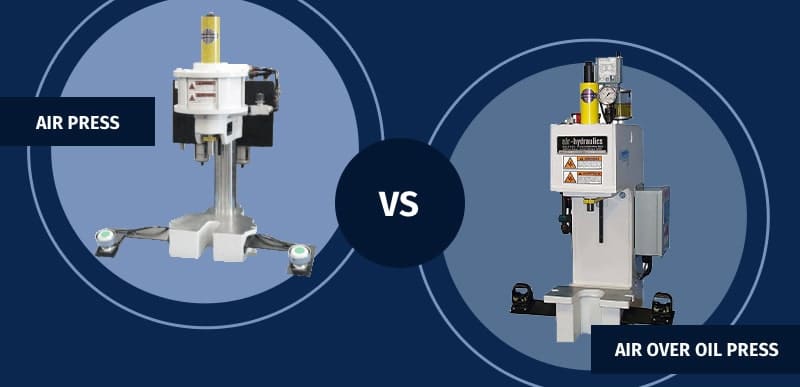
When it comes to tough assembly and metalforming jobs, a great factory press is an essential tool. But, there are many different types of presses to choose from. Two of the more affordable and easily usable types of industrial presses are air presses (AKA pneumatic presses) and air over oil presses (AKA hydropneumatic presses). So, what’s the difference between an air press vs an air over oil press?

Air Press vs Air Over Oil Press: What’s the Difference?

What is an Air Press?

An air press and an air over oil press are similar, but there are some important differences. An air press, or pneumatic press, uses compressed air in a series of cylinders to create force. The compressed gas contained in the cylinder can be regular air, mostly nitrogen and oxygen, or compressed nitrogen. When the air is compressed further in the cylinder, it creates pressure anywhere between 10psi and 5,000psi, which can then be used for a wide variety of assembly applications, riveting, punching, forming and other jobs.

What is an Air Over Oil Press?

An air over oil press, or hydropneumatic press, uses hydraulic and pneumatic technology to create force. This system uses compressed air to drive a piston that compresses hydraulic fluid. These technologies combined can create even more force than a pneumatic press, and can create force comparable to a full hydraulic press.

Air Press vs Air Over Oil Press: How Are They Similar?

Air presses and air over oil presses are similar in many ways. Both use pneumatic technology to create force. They also operate in similar ways, and have similar safety mechanisms and features. An air press and an air over oil press both require similar power needs, and have similar maintenance schedules. Compared to a purely hydraulic press, the air press and air over oil press also have less intense maintenance schedules.

Comparing an air press vs air over oil press, there are a few similarities:

  • Both use compressed air to generate force
  • Similar maintenance schedules
  • Similar power requirements
  • Similar safety mechanisms
  • Similar operation

Air Press Vs Air Over Oil Press: How Are They Different?

Though there are many similarities, there are also several important differences between an air press and an air over oil press. Since it uses hydraulic technology combined with compressed air, the air over oil press can exert more maximum pressure than a purely pneumatic press. An air press can exert between 150 and 5,000 lbs (2.5 tons) of force, while an air over oil press can exert between 2.5 and 50 tons of force. For this reason, an air press and an air over oil press are each ideal for different jobs and applications. An air press may be used for light applications like assembly, riveting, punching, staking, stamping, crimping, and similar tasks. An air over oil press may be used for heavier applications like bushing and bearing insertion, stud insertion, broaching, swaging, trimming, notching, and similar tasks.

Browse information and recommended presses by Industrial Press Application >

Another important difference between an air press vs an air over oil press is the costs associated with each. While they have similar maintenance schedules and costs to maintain, an air over oil press can exert more force and costs more to purchase. However, an air over oil press is generally more affordable than a purely hydraulic press. Finally, an air over oil press will be slightly larger and take up more space in your shop than an air press.

Comparing an air press vs air over oil press, there are a number of important differences:

  • An air over oil press can exert more maximum force than an air press
  • Each press is ideal for different jobs
  • An air over oil press costs more to purchase than an air press
  • An air over oil press has a larger footprint than an air press

Both an air press and an air over oil press have similarities as well as important differences. Which one is right for your shop will depend on your primary application, your budget, your shop layout, and more. If you’re unsure which type of press is right for you, contact us. We can help you find the right fit for your needs.