
When it comes to metal forming applications, there are many different jobs to be performed, and many different presses that can meet the challenge. Finding the best presses for metal forming applications requires first analyzing your process and materials, as well as your facilities and surrounding processes. The right press for your metal forming application will not only accomplish the job seamlessly, but also fits comfortably and efficiently into your existing processes.
The Best Presses for Metal Forming Applications
Before we take a look at the different factors which can help you choose the best press for metal forming, let’s take a look at some example presses that are ideal for metal forming.
The ideal press for metal forming applications might be hydraulic, hydropneumatic, or even pneumatic. Considering how much force you need will help you hone in on the right press, without overspending on power and energy consumption that you don’t need.
Here are a few presses that can perform a variety of metal forming applications:
- A-Series adjustable air press (1200-5000 lb): This pneumatic press provides a wide force output range, and it’s adjustability makes it easier to fit into your facility. It can also help with ergonomics, and make the task more efficient and comfortable for operators.
- C-Series (2.5-15 ton): This heavy-duty press performs a wide variety of metal forming tasks, even with particularly tough metals.
- AP-Series Black and Webster Air Press (150-1900 lb): This more compact press works well for smaller operations, softer metals, or more delicate work.
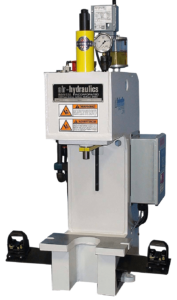
- AH-Series Hydropneumatic Press (4-50 ton): This hydropneumatic press gives you a high degree of force for demanding metal forming jobs, while also reducing maintenance and costs compared to a fully hydraulic press.
- HP-Series Hydraulic Press (20-50 ton): This hydraulic press exerts a great deal of force, and can work particularly well for applications with very hard-to-work-with materials.
- SH-Series Compact Hydraulic Press (2.5-15 ton): This smaller hydraulic press still provides a high level of force, while also fitting more easily into smaller settings.
Interested in presses for metal forming?
Tell us about your process and requirements, and we’ll help you find the right press.
Choosing the Best Presses for Metal Forming Applications
To choose the best press for your metal forming applications it’s important to consider several different factors. With these considerations in mind, you’ll be able to find the best fit for your needs and facilities.
1. Process Requirements
Different metal forming processes require unique press capabilities, so identifying your main forming process is the first step.
- Bending: For bending applications, finding a press with a large power stroke is critical to ensuring the full force is applied for long enough to bend the material to the correct shape. A press that provides high repeatability and control is also essential to achieve an accurate bend consistently.
- Deep Drawing: This process requires high tonnage and smooth control to form complex, hollow shapes without damaging the metal. Look for presses with high force application applied along the full stroke that will be able to handle the constant pressure required for deep draw processes.
- Impact Extrusion: Used to shape metals rapidly, impact extrusion requires a press that can handle high force over short cycles.
- Cutting and Shearing: Cutting applications need presses with robust, high-speed performance to create clean edges when shearing material, as well as to maintain accuracy and efficiency in repetitive tasks.
Matching your press capabilities to these process-specific needs will help, as each application has unique demands when it comes to force, speed, and precision.
| Application | Industries | Materials | Recommended Press |
|---|---|---|---|
| Light assembly, Riveting, Punching, Marking, Staking, Crimping, Forming, Swaging | Medical, Aerospace | Plastics, Mild Steel, Aluminum, Brass, Cooper | Adjustable air press, 1200 lbs to 2.5 tons |
| Bushing/Bearing Insertion, Stud Insertion, Swaging, Trimming, Marking or Character Stamping, Assembly, Notching, Joining, Forming, and Fastening | Automotive, Agriculture, Aerospace | Mild or Carbon Steel, Harder Aluminum, Cast iron, stainless steel, other alloys | Pneumatic or hydropneumatic press, 2.5 to 15 tons |
| Bushing/Bearing Insertion, Stud Insertion, Broaching, Swaging, Trimming, Assembly, Notching, Joining, Forming, and Fastening | Automotive, Agriculture, Aerospace | Mild or Carbon Steel, Harder Aluminum, Cast Iron, Stainless Steel, Alloys | Hydraulic press, 20 to 50 tons |
2. Metals
Different metals react to forming forces in unique ways, making the material a vital factor in your press selection. Some metals are very resistant to metal forming, so they need a press with high force output. Other metals are resistant to impacts, but they are not very malleable, and they will snap more easily with high, sudden amounts of force.
- Steel: For steel forming, a press must generate high force to manipulate the metal effectively. Hydraulic or hydropneumatic presses are often best for these applications due to their controllable, high-tonnage force.
- Aluminum: Lightweight and malleable, aluminum often requires less force than steel. Mechanical presses with adjustable settings can be ideal for aluminum applications, providing the necessary speed and precision without excessive force.
- Stainless Steel: Known for its hardness, stainless steel can require high tonnage similar to standard steel. Consider hydraulic presses with cooling systems for sustained performance.
Evaluating how each metal behaves under stress helps ensure that your press won’t apply unnecessary force, which can damage parts or lead to increased wear and tear on the machine itself.
3. Press Tonnage Required
Tonnage is a key metric that determines how much force the press can exert. To select the correct press tonnage, you’ll need to calculate the force needed for your specific forming process and materials.
For example, bending mild steel might require a press with lower tonnage than deep drawing stainless steel due to the latter’s need for high force over a larger surface area. Aluminum impact extrusion typically requires a lower tonnage press than steel.
Working with an equipment specialist can help you calculate your tonnage needs accurately, ensuring your press can handle the force requirements without risk of damage.
4. Precision and Repeatability
For applications where precision is critical, such as aerospace or medical manufacturing, look for a press with advanced control features and high repeatability.
- Servo presses stand out for precision work due to their direct drive control, making them ideal for intricate bending or forming parts that require consistent accuracy.
- Force and distance monitoring capabilities also help to reduce errors, and show immediately whether or not the process has met the parameters.
Selecting a press with high repeatability and accuracy reduces errors and ensures product consistency, particularly in high-stakes industries.
5. Long-Term Maintenance Needs and Support
Finally, choosing a press with minimal maintenance needs and strong manufacturer support can reduce operational costs over time.
- Hydraulic presses may require regular fluid maintenance and inspections, so consider your available maintenance resources.
- Hydropneumatic presses typically require less maintenance and upkeep compared to fully hydraulic presses, thanks to their additional air-powered system components.
- Pneumatic presses also typically require less maintenance and upkeep compared to hydraulic presses.
Additionally, work with a press provider that offers reliable support to ensure your press remains in peak condition for years. Many of our quality built production and assembly presses are still in use after 50 years or more. We have even worked with customers to refurbish existing presses to current performance standards to keep them running well and save our customers the high new investment costs.
Selecting the right press for metal forming can be challenging, but understanding the requirements of your forming process will help you make a well-informed decision. Working closely with a knowledgeable and experienced press manufacturer will help make the decision easier, and help you find the right fit for your needs and challenges. With over 80 years of experience with factory presses, Air Hydraulics Inc can help you find the right press for metal forming applications. Contact us to get started.